Wednesday, November 17, 2021

What is Natural Law: A Brief Explanation and Defense

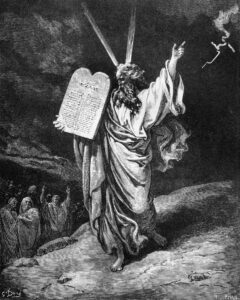
When seeking to discern between good and bad, I can look to myself or look to others or look to both myself and others. Initially, it may seem justified to adjudicate between good and bad by looking to myself. After all, I am a sensible, reasonable person. I am not a sociopath or cognitively incapacitated. Moreover, I am ultimately the one making the moral decisions, and so they will most likely impact me, so I should have a say in what I think to be good and bad. However, upon further consideration I realize that I have made mistakes in the past. That is to say, I have made errors in judgment including moral judgment. So, I recognize that I have blind spots or biases that may be unknown to me. Often, I have been unaware of my mistakes until someone else shed the light of reason to illuminate the proper way. I conclude from this self-reflection one non-negotiable truth: I am fallible. So, it seems that the final option makes the most sense to look both to myself and others because I am both a rational person with agency and I will be affected but I am also a fallible person prone to error. Any proper way of thinking about ethics should account both for my own moral intuitions and the wisdom of others. But what sorts of people should I turn to? In matters of medicine, I would turn to doctors; doctors who have both studied medicine and anatomy and mastered the practice of health care. In matters of culinary arts, I would turn to chefs; chefs who have studied spices and cooking methods and mastered the practice of cuisine. In matters of good and bad, it would reasonably follow, that I would turn to those people who have thought carefully and deeply about such matters, and not only that, but those who have also mastered the art of living well; that is to say become themselves good people. There are such people universally recognized in the history of the world whose writings are still available: Moses, Solomon, Socrates, Cicero, Jesus, Paul, Buddha, Confucius, Thomas Aquinas, Elizabeth Anscombe, to name a few. Upon reading and examining these figures they are different in that they are distanced by chronology and geography; they lived across centuries in different parts of the world, grew up in different cultures and spoke different languages. However, upon examining these figures they all have something in common they believe: that there is a moral order. They believe there is a universal, moral order, that it could be known, and they believed their job was to inquire into that order, study it, and conform themselves to it in order to flourish. Indeed, all of them offer a vision of what it means to live a flourishing life, what it means to live well, and central to that vision is an acquiescence to the moral order. In order to live well, we must live our lives in accord with the structure or blueprint within the universe. In doing so, we develop moral and intellectual virtues which are necessary and essential for a properly flourishing human life. When humans fail to do that, things go awry. In other words, when we push against the walls of reality, they push back. If we violate the order of creation, by attempting to fly out of a window for example, the walls of reality push back, and we break our legs. They remind us that they are there and what our place and purpose is within them. How does one go about seeing and seeking this moral order in the universe? According to the Judeo- Christian tradition, it is revealed to us in nature: in creation (the physical created order) and in human nature. The moral order is woven into the fabric of creation. To go against it, is to go against the grain of nature. As St. Paul says, these things are written on the heart and revealed to all in the physical creation. Of course, creation implies a Creator, but what seems apparent is that even apart from immediate or specific, detailed understanding of the Creator, one can know good from bad. This is consonant with the fact that moral law codes of non-Jewish peoples that predate the Ten Commandments by hundreds of years are quite similar to the law codes of Moses. That is to say, it is not because Moses or his predecessors were inventing moral laws previously unknown to humankind, but that somehow, they discovered them, or as the Christian tradition would claim, they received them. Indeed, this seems to be true even today. For most of us as human beings, there are some goods that flatten out at rock bottom and are apparently obvious goods that they require no further argumentation, the good of life, for example. If you were to find yourself arguing against the evil of genocide on the basis of the good of human life, and someone responded with confusion, “But why is human life good?” you might reasonably think you were talking with someone whose reason is seriously impaired and whose moral sense is broken much like a physical sense. Hence, I am able to come back to where I initially began: my inner self. My own conscience dictates that some moral realities are apparent to me and within me, accessible through reason. It is obvious to rational human persons that life is good. I am compelled to see and value certain goods. Consequently, we as human communities make moral precepts such as life should be preserved and protected. One need only recognize one’s nature and the nature of the world around him to affirm this. In the words of Martin Luther King Jr., the way one knows if a civil law is a bad law or good law is if it violates the natural law. So, we can say this moral order is written on our hearts. But how else can we know this moral order? Again, we must return to nature. In order to know whether something is good or bad, we need to know its nature. To inquire into a thing’s nature is to ask about the essence of the thing. And in order to know its nature, we need to know what its purpose is, what is it made for. For example, I can discern a good clock from a bad clock because I know what a clock is made for or its purpose. A clock tells time. A clock that does not tell time is a bad clock. A clock that does not tell time is rightfully said to be broken. Similarly, a plant strives to grow and reproduce. A plant that grows and reproduces properly flourishes. In fact, flourishing is an apt term as it relates to us human beings because since we share something in common with plants, namely we are organisms. This notion that objects have purposes, things for which they aim or are made for is called teleology. Similarly, human beings are made for something, they have a purpose, a telos, an end. Anthropology then lies at the heart of the ethical question. In order to ask the question how then should I live? We must first answer the prior question, what does it mean to be human? What are human beings and what are human beings made for? Since the 18th century and accelerated in 20th century, the answer to anthropological question is boldly, “nothing.” Indeed, the answer given repeatedly in the 20th century (with some important exceptions such as Chesterton, Anscombe, and Lewis) is to reject human nature altogether. There is no such thing as human nature some (notably Nietzsche and Sartre) say. Human beings are not made for anything. In fact, what makes us humans is the fact that we can create or impose, by the sheer act our own will, what our purpose, our telos is. The individual decides, chooses, and creates itself, and none can tell him otherwise. This answer is novel in the history of humanity broadly and in the history of ethical thinkers, and we are in a 100-year experiment witnessing its effects. If there is no moral order, then as C.S. Lewis predicted all we are left with are value judgments reduced to mere statements of individual, emotional expression with no substance or content that can be reasonably evaluated. Conversations simply devolve into emotional ping pong, where each individual shares his or her feelings about an issue. Each one is free to construct his or her own moral reality and creatively explore their individuality and autonomy. Individual choice reigns supreme. But why think such a conception is true and not disastrous? As Christina Hoff Sommers notes, leaving humans, especially young humans, alone to compose their own values is a little like putting them in a chemistry lab and saying, “invent your own compounds.” This is because the moral law like physicals laws is not invented but discovered. To be sure, contemporary culture has broadly rejected teleology, and its consequent has been the normalization of everything. On the other hand, if eyes are in fact for seeing and ears for hearing, then we are teleological creatures; we live in a teleological reality. If one pushes against the walls of reality, inevitably they will push back. The Christian natural law thinker readily concedes that though there is much good in nature and those goods are evident to us, nature is also fallen. Things are not the way they are supposed to be. Creatures like us are different from plants in that we have been given a great deal of agency as to how we respond to God’s desires and purposes for creation, and our desires and disposition is often to push away. The fall does not deprive us of our nature, but, in the words of J. Budziszewski, our nature is not in its intended condition. We often aim and desire that which is destructive to us. We have habitual vices, biases, are willfully ignorant, and seek to often serve our own self-interests at whatever cost. Nevertheless, all of us still recognize that things can and should be better. According to the Christian story, God takes on human nature, becomes flesh, to restore and redeem human nature and with it all of creation. So, this leads finally to how we see and seek this moral order. Because humans are finite, fallen, and fallible this moral order is best sought in a community of Truth seekers; truth seekers who themselves possess moral and intellectual virtues. Indeed, one thing common to the great moral thinkers of the world is that they were in the pursuit of moral truth in community. In the Christian tradition, this community is meant to be the church filled with the Spirit of God. This conception of a moral order woven into the fabric of creation, universally apparent to all human beings via reason is called natural law. While natural law is not exclusively unique to the Christian tradition, the Christian tradition offers the best account for this moral order. The Creator God who created our individual minds is the same God who created the external world around us, and who left His imprint both on us and broadly on his creation. One mark on his creation is order that reflects the eternal divine intelligence or divine wisdom. However, natural law has been forgotten for some in the Christian tradition, particularly among evangelical Protestants. In an attempt to retrieve the authority of Scripture, what has been plainly revealed in creation has been neglected or ignored. The result has often been rules without reasons. Prudence and wisdom along with other moral and intellectual virtues have little to no value when one has a divinely inspired command in Scripture. This approach to Scripture can be called biblicism. The reason murder is wrong is because the Bible says it’s wrong. Practices of hygiene and cleanliness can be justified by appealing to the Psalmist’s words to create in him a clean heart. Furthermore, as Gregory Morris notes, “roles, duties, and moral facts which generations of Christians before us would have seen as self-evident now puzzle evangelicals, who take the view that whatever the Bible doesn’t forbid is allowed. The idea that nature tells us things about morality, about the intended function of our bodies, about the roles of the sexes, or about the purposes of our institutions is alien to the evangelical mind. If the Bible doesn’t explicitly require something, it is optional.” Subtle forms of functional Gnosticism have crept in to suggest it makes no difference what our physical bodies do. Regarding such matters, freedom and individual conscience reign supreme. So, such an evangelical finds himself a strange bedfellow with those 20th century thinkers who deny human nature altogether and say, “to each his own.” The natural law thinker says otherwise. The reason murder is wrong is not because the Bible says so. Rather the Bible reiterates and clarifies what is revealed to us in nature as God’s will. The Scriptures may mandate the avoidance of drunkenness, and the toxicologist can explain why. The scriptures may mandate marital fidelity and the marriage counselor or medical doctor can explain why. The scriptures may mandate care for vegetation and plants, and the climatologist can explain why. There are certain things we need as humans to thrive and flourish that include oxygen and food. But there are other things like ordering our desires, practices and habits. Thus, we see the beautiful harmony between the sciences and theology. We are not left rules without reasons. Virtues such as self-control, patience, and charity are developed in how we think about alcohol, gardening, marriage, and so forth. Consequently, the Christian concerned with developing her virtues and ordering her desires does not perpetually ask, “Is this lawful or unlawful?” Rather, she asks, “will this lead to life or lead to death?” Will this promote flourishing or destruction? Is this fitting for my nature or devastating to my nature? Given much of evangelicalism’s allergy to works righteousness, it is tempting to quickly label certain attitudes and practices as legalistic. However, if there are virtues beyond simple obedience, we must cultivate them. If we have a nature made for a purpose, we must seek to live in concord with it, not fight against it. This is no easy thing. As James Hunter notes, “We say we want a renewal of character in our day but we don't really know what we ask for. To have a renewal of character is to have a renewal of creedal order that constraints, limits, binds, obligates, and compels. We want strong morality but without the emotional burden of guilt or shame; we want virtue but without particular moral justifications that invariably offend; we want good without having to name evil; we want moral community without any limitations to personal freedom. In short, we want what we cannot possibly have on the terms that we want it." Therefore, the vision of thinkers like Nietzsche and Sartre and evangelical biblicists must be shed. Recovery of the natural law, a fully orbed commitment to God’s creation is the way forward. For Further Reading: Aristotle Nicomachean Ethics Cicero On Duties Paul Romans 1-2 Thomas Aquinas, Summa Theologiae Treatise on Law C.S. Lewis Abolition of Man
Sunday, August 15, 2021

Deconstructing Fundamentalism, with Sheb Varghese

Saturday, August 14, 2021

Deconversion, with Esther O'Reilly

Wednesday, January 6, 2021

Emotion and Plato, with Joel Potter

emotion and plato, christian philosophy, sheb varghese, faith colloquium

Monday, November 9, 2020

Theological Anthropology, with Joshua Farris

theological-anthropology,-with-josh-farris,-sheb-varghese-christian-philosophy-podcast

Saturday, October 24, 2020

Sunday, September 13, 2020

The State of Higher Education, with John Mark Reynolds

the future of higher education, john mark reynolds, faith colloquium, sheb varghese

Monday, August 24, 2020

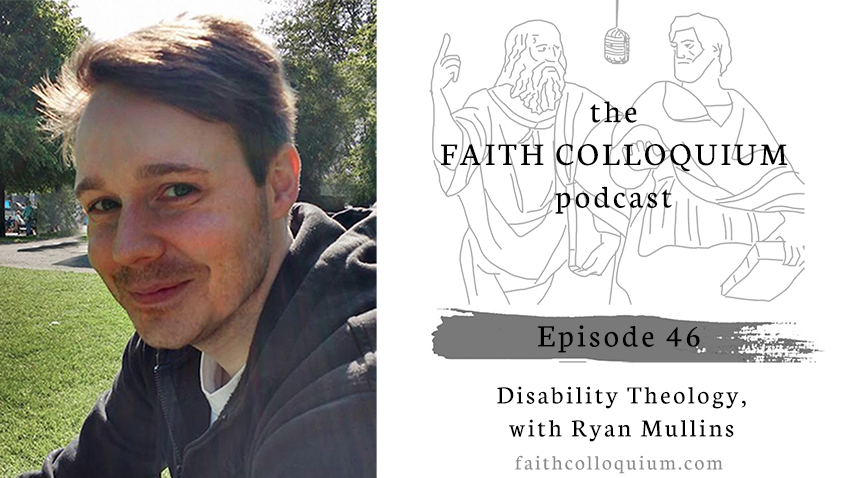
Disability Theology, with Ryan Mullins

Ryan Mullins, Disability Theology

Wednesday, August 5, 2020

Baptism, with Gavin Ortlund & Richard Pratt Jr.

baptism, gavin ortlund, richard pratt jr. faith colloquium podcast, shebuel varghese

Wednesday, July 22, 2020

Intellectual Virtues, with Nate King

intellectual virtues, nate king whitworth university

Wednesday, June 10, 2020

Contradictions in the Bible, with Mike Kibbe

contradictions in the bible, mike kibbe, great northern university, spokane christian college, washington state christian univerisities, conservative universities in america

Tuesday, May 26, 2020

Providence, with Ryan Mullins & Ron Highfield

 ryan mullins, ron highfield, sheb varghese, providence, philosophy podcast, faith colloquium How does God govern the world? What is middle knowledge? Listen in with Ryan Mullins and Ron Highfield

Tuesday, May 19, 2020

Reading Poetry, with Kjerstin Kauffman

reading poetry, kjerstin kauffman

Monday, May 11, 2020

Classical Christian Education, with Wade Ortego

Wade Ortego, Classical Christian Education, Circe Institute, Society for Classical Learning, Association of Classical Christian Schools

Wednesday, May 6, 2020

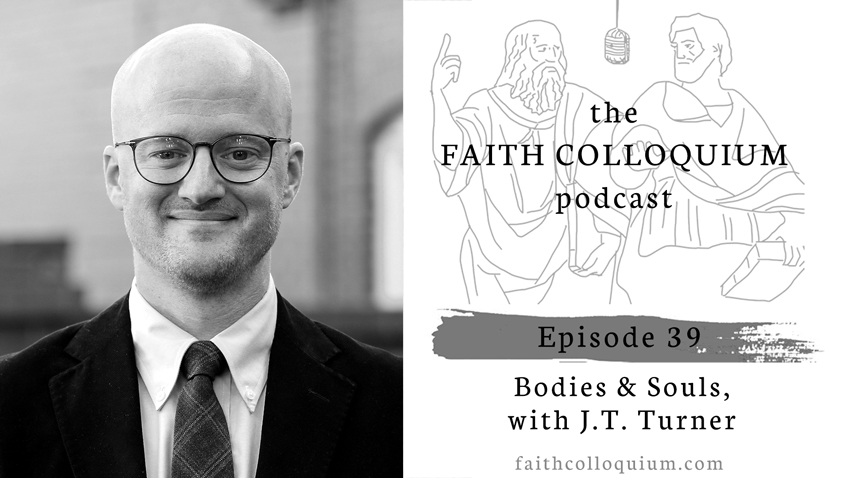
Bodies & Souls, with J.T. Turner

Bodies & Souls, with J.T. Turner Are we bodies or souls? What is hylomorphism? What is physicalism? What is substance dualism? Listen in with J.T. Turner as we talk about anthropology.

Wednesday, April 29, 2020

John Piper was Right

Remember back in 2010 when John Piper said that nobody will be talking about the "emerging church" in ten years? Well, he was right.

Friday, April 24, 2020

The Historical Adam, with Joshua Swamidass

historical adam, reading Genesis, evolutionary creation, progressive creation, Was there a historical Adam? Is there a conflict between Evolution and the creation story? Listen in with Joshua Swamidass as we discuss his latest book, The Genealogical Adam and Eve.
Friday, April 17, 2020

Functional Gnosticism

 As Christians we believe the fact that we exist as embodied creatures is not inconsequential. The Judeo-Christian tradition has always upheld the sacredness of the physical world. Attentive thinkers from Paul to C.S. Lewis have argued that, contra the notion that our bodies are unfortunate barriers and irrelevant to our identities, matter matters to God.

The Gnostic philosophy that offered an alternative reality unencumbered by the physical world where we can we find our true selves, was one that Christians took head on in the early church. Could one be both a Gnostic and a faithful Christian? No. Against Gnosticism, the church draws upon its rich resources from the creation narrative itself in which God makes Adam from the dust of the ground to the early creeds which confess that God "was incarnate and was made man," as we (try to) answer the question, "What does it mean to be human?"

Moreover, it is on the grounds that we think our bodies matter that Christian ethics calls for a strict stance on sexual practice, for example. But of course, the necessary presuppositions in place in order to make the argument for something like historical, orthodox Christian sexual ethics have so disappeared in the modern Western world that it's become near impossible to make a reasonable sounding case for it. Additionally, ours is a world where reality is malleable. With the increasing powers of technology that can (seemingly) replace, extend, or even manufacture things into our existence, Christians too face increasing challenges to our own sense of what it even means to be made in the image of God.

Not to mention the ever encroaching reality of transhumanism. Perhaps no longer will we proclaim at funerals,"to dust you shall return" but "to virtual reality you shall go." As philosopher Douglas Groothius says, "To reverse the biblical statement, what is impossible with God is possible with programmers."

This is no longer merely in the realm of science fiction. Back in 1995, Nicholas Negroponte described a new social culture where "we will socialize in digital neighborhoods in which physical space will be irrelevant and time will play a different role." ...Sound familiar?

Can we still really affirm the spirituality of materiality in the modern world?

In fact, Joseph Minich points out that this is why atheism has such aesthetic plausibility even to religious people— because of our tacit sense that reality has been shaped by modern technological culture. Through the powers of technology not only can we predict reality, we can even control it. Again if all this is true, where does this situate us as human beings? What are we in this whole technological landscape?

In the midst of all this, the coronavirus has struck, and has put a halt to our communal gatherings.

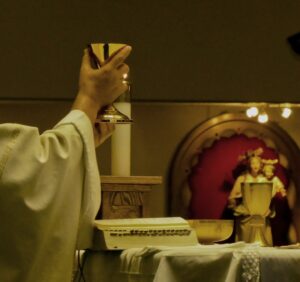
In response, Christian schools and religious communities are turning to online tools like Zoom; Churches are live-streaming their services. Such a response might reveal our own proclivities to think that the primary reliable sources for improving the human condition stem from technology. And in the mean time, sacramentally oriented Christians like myself have especially had to wrestle with all the questions around the partaking of the Eucharist or absence thereof.  But this is where the sacramentalogical rubber meets the road...

I'm personally compelled by the response of Mark Dever (a Baptist!) who chose not to offer any online services at his church, and instead exhorted his congregants to stay disconsolate in their homes due to his conviction that the ecclesial assembly is so sacred there is no substitute for it saying, "A video sermon is not a substitute for a covenanted congregation assembling together and all the various means of grace in that. A providential time of abstinence could have good, chastening soul benefits. More useful than a part of a service people may mistake for a substitute."

Dever's remarks seem to be wholly consistent with the Scriptural language around ecclesiology. Just consider that the Greek word ekklesia means assembly or the exhortations in the epistles to "greet one another with holy kiss" or how Peter, James and John extended "the right hand of fellowship" to Paul. Surely, there's something deeply counter-intuitive about celebrating the resurrection of the body of our Lord and the renewal of creation through a virtual platform.

Beyond that, this response strikes me as attentive to the way that we do not simply stand above and beyond technological objects, but we are also formed by them, and the way in which we engage in certain practices have forming impacts upon us whether we realize it or not. Again to quote from Doug Groothius, "technological change is neither additive or substractive, but ecological. Removing a television from a typical teenager's room is not simply the subtraction of a piece of furniture; it alters the ecology. The room is no longer the entertainment center it once was; books may now be retrieved from dusty shelves; conversations once muted by video may now flourish; boredom may beckon."

But when it's all over, and when things return to normal, what will we do then? How will we proceed? Will we look back at this time and think what a blessing in disguise that we uncovered how to fully utilize the effective technology that we've been missing in our lives? Will we recall and mourn the loss of true embodied relationships for which there is no genuine replacement?

There's no doubt that technology has been the means through which much hardship has been alleviated, and much good has come about. (Yes, I'm writing this on a computer!) But the swiftness and pragmatism of diving in now and reflecting later, some times entails the damage cannot be undone.

For evangelicals who desire to uphold the goodness of the physical created order, now is our chance to prove it. Or will we capitulate and contribute to neglecting the values and principles required in order to defend a distinctly Christian way of life? Will we view this as an opportunity for the ever increasing greatness of technology to serve as a substitute for flesh and blood relations? Will those churches and institutions who were already flirting with the allures of technology prior to the pandemic dial back or go full throttle as a result of these events? Or will this point us even deeper to the recognition affirmed by Scripture that we are bodily earthen vessels who await to see our God face to face?


Evangelical Anglican, Charismatic Anglican, Liturgical Christian, Why Churches should not use Zoom, Why Churches should not meet online, Why Church can't stream online, Mark Dever Capitol Hill Baptist, What's wrong with online church, Malayalee Pentecostal, Marthoma Christians, Malankara Church, Syrian Orthodox Christians, Can we do online church, should we do online church, can we have church online, can we use zoom for church, can we use zoom for communion, can we do communion online, we can do communion over zoom, can we do church over zoom, can we do church online, should we do eucharist at home, should we do eucharist over zoom, eucharist and the coronavirus, can we partake of sacraments over zoom, is it okay to do communion at home

Wednesday, April 15, 2020

Friday, April 3, 2020

What’s Wrong with Apologetics?

I've been an apologetics enthusiast ever since I watched William Lane Craig as a sophomore in high school. Like many, I grew up a little Craig-disciple echoing the oft repeated arguments I heard. I loved watching the debates, the conferences, the panels. (In fact, I wrote my high school senior thesis on the moral argument for God's existence.) That love persisted throughout college as I chose to major in philosophy. At one point I wrote a post titled "4 Reasons Not to Dismiss Apologetics," and the very first entries I wrote for this blog (six years ago now!) are titled, "Why I Believe in God" where I rehash a few of the standard theistic arguments. After graduate school, I even taught Apologetics at a Christian college. And through my current work, I still desire to engage in the task of defending and explaining the truth of the Christian faith. All of this to say, I have a deep appreciation for apologetics.

But something has gone wrong in modern day apologetics, and I think it has something to do with the absence of a sapiential approach to these matters. Instead what we often find is a commercialization of apologetics with little to no attention to the careful and thoughtful nuances around the Christian faith (or religious faith in general), much less a holistic vision of the Christian life. Christian colleges and seminaries began advertising degrees in apologetics. The selling line was that students will be taught a Christian worldview (about which others have offered critical insights - see here and here and here.) People could come for a year or two and "study apologetics," or "get a diploma in apologetics," a phenomena which makes as much sense to me as getting a degree in ministry. Before if there were Christians apologists who had advanced degrees in New Testament history or philosophy of religion, now there are Christian apologists who have degrees in apologetics. Perhaps this underscores the pragmatism of both our educational institutions and evangelical culture.

More to it, consider the promotional language apologists regularly exercise over the internet: PROOF JESUS ROSE FROM THE DEAD, HE DESTROYS ATHEISM, SCIENTIST PROVES EXISTENCE OF GOD...the inflated language that markets well in the age of social media. I've observed it and felt the tug of it. Nevertheless, such exaggerated articulations often merely invite evangelical Christians to collect ammunition against atheists, and neglects the genuine challenges and pricepoints of believing that Christianity is true, as though there were no pills we Christians have to swallow. One unintended result of such speech is the reduction of the Christian faith to a set of propositions or abstract beliefs, divorced from the real struggles one expects to find in a relationship with another.

For some, this methodology of apologetics has made its way into how they raise their children, and even become something of an industry. A popular Christian apologist blogger wrote a piece titled, Over 60 apologetics questions every Christian parent needs to learn to answer. Questions include: "Why would God allow evil to exist? Why would God command the death of the Canaanites? Are there contradictions in the Bible and how do we explain them? Why does God remain so hidden?" I have a graduate degree in theology and I don't think I have great answers to these questions! (And I'm not alone. See David Bentley Hart's commendable response to the problem of evil.) Of course, that isn't to say there are no (reasonable) answers, nor that Christian parents shouldn't desire to have answers but the title's exhortation is that every parent would possess ready rebuttals to know how to answer each of these questions, and there are dozens more. The unstated and unrealized expectation is that every Christian parent would be proficient in biblical languages, history, philosophy of religion, biology, as if isolated individuals could carry the brunt of the apologetic load which simply is not possible. And this segues into my other major concern with modern day apologetics: it is divorced from ecclesiology. I hardly ever see apologists speak of their church traditions and how their ecclesial traditions possess the valuable and helpful resources for seekers and doubters. (Against this, see Abigail Favale). So often Christian apologists speak as though they were arguing from a sort of ecclesiological view from nowhere. Isn't the local church community supposed to be the space in which we ask such important questions, and in which we might walk with people who are doubting? What of the function of intellectual virtues fostered in a community of faith? What ever happened to proper authority and responsibility pastors had as Christians in the community wrestled with these questions?

Instead the current approach is that there are ready-made answers mass produced like pre-prepared kits. Apologetics has become increasingly industrialized, and much of modern apologetics is now about merely downloading a new set of data that young Christians did not have before which will inoculate them from doubt.

Indeed, some apologists today seem to think that what the skeptic, the unbeliever, the doubter primarily needs is information. And in some circumstances, perhaps that might be right. I don't doubt that many are benefited from an exposure to traditional defenses of Christianity. (Thank God for the work of William Lane Craig and Richard Swinburne!) But I wonder how many people leave the Christian faith because they are struggling with the possibility of a multiverse, or the inconsistencies in the gospels. My suspicion is most people develop doubts over Christianity because God didn't seem to answer their prayers, or they develop deep relationships with non-Christians, or they are drawn to certain social-political movements, or the Christian leaders they knew seemed insincere or even betray them, or they find compelling answers elsewhere that offer them a better, more plausible story, or their desires and vision of a flourishing life no longer corresponds to the one they were raised to believe.

This isn't to ignore the legitimately good work done by many apologetics ministries out there. You won't hear expressions like "Arguments never save anyone" from me. Lest anyone misunderstand my convictions, I think  Christianity is true and rational, partly as a result of good arguments, and I unabashedly identify as a Christian. But the Christian faith is not without its difficulties; Christianity can be complicated and human beings are complicated. Ideologies do no not exist independently in the abstract. Our beliefs are not disconnected compartments, which can be pre-packaged or into which things can simply be downloaded. Rather our beliefs form integrated wholes. Our beliefs and our desires constitute coordinate wholes. And apologists who narrowly focus on merely packaging data I suggest have a myopic picture of human persons and reality, and do so at the expense of their own Christian witness.